Monday, June 29, 2009

When Up is Down. (part 1)

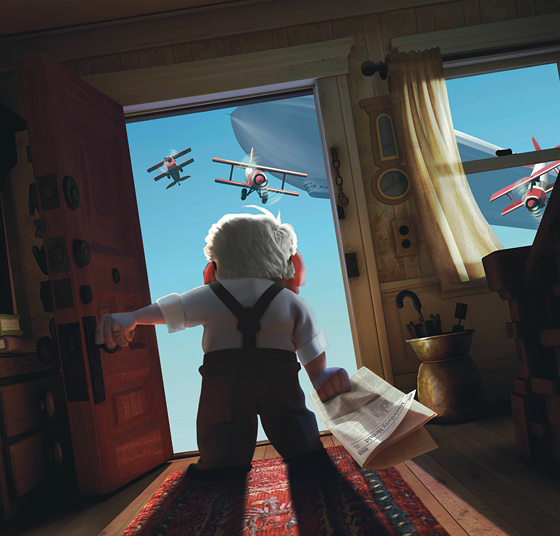
Okay, so I didn't like Up all that much. I didn't hate it. It was certainly better than Cars and I know I tend to expect too much from PIXAR films, so I'm not angry or anything.

And sure, at least it was better than Transformers.

But should that really be our standard?

Let me tell you why I didn't dig Up and then tell you why it matters: It wasn't the dogs who can't talk without special collars but who can fly planes. It wasn't that the great explorer from the beginning of the film somehow garnered an unlimited budget and sci-fi toys that would make Captain Nemo light a cigarette. It wasn't even the fact that his transformation into the villain was utterly and totally spontaneous and unbelievable (or that at the end of the film he's supposed to be over 100 years old but can still go toe-to-toe with our senior-citizen hero).

And it wasn't the annoying kid, the annoying bird, or the annoying voice of the villainous dog.

It was that so many people agree with all of the above but then shrug and say, "But I looooooved it. It was soooo cute."

I was talking with my composer friend just a few days ago and we were discussing how ABC kids Television and the Disney Channel use music not to serve a good story but to compensate for a bad one. Like TGIF's Family Matters or Full House, there comes a time in the show when the "touching music" starts that tells you how to feel, no matter how lame the previous 15 minutes were. This music is usually added to the rockin' interlude before and after commercial breaks to give you a jolt of energy before the laugh track kicks in.

Now, my friend is an amazing composer. He's done great music for great stories. And the people who do the ABC/Disney stuff do fine work and work hard...but I garuntee you they long to do something else. They'd all love to work for PIXAR. (They all probably long to work with my friend).

But PIXAR, the pioneer in computer animation, has gotten so good at creating lush, believable and completely compelling environments that they have, perhaps accidentally, wandered into a new world of story-telling temptation:

They are now tempted to do visually what Full House did musically.

And this is where Transformers and Up actually have one thing in common: where Transformers uses explosions and Megan Fox's thighs to cover up for a horrible story, PIXAR can now use fluffy clouds and cute birds to cover up for their average story.

Because lets praise it: Up, while not the greatest thing ever, is a elegant concept. And the first 10 minutes should be cut and submitted for best short film for the Academy Awards.

But I don't need to have a touching moment every 5 minutes in order to appreciate a good story, and when the film keeps bombarding me with cutesy "aw" moments I start to get nervous like someone is trying to steal my wallet.

This phenomena begins to devolve the story into a "how much can we get people to feel" game rather than a "what are we trying to say" game. One is sentimental, the other is substantive.

PIXAR is known throughout the world for it's substance. Michael Bay is (usually) not. I'm fine with one inspiring the other...I just want to make sure it's the former inspiring the latter.

Wednesday, June 17, 2009

The Usual Suspects.


"What's your favorite movie?"

When I teach classes or lead discussions or have to (for some horrible reason) facilitate ice-breakers I usually use this question. I love film, and so for me it's a fun question to answer and most people have an opinion about it.

For me, for years, I used to say The Usual Suspects was my favorite film. I'd even follow up my answer with "best ending ever!"

And then The 6th Sense came out.

Then I saw Braveheart, The Shawshank Redemption, and Good Will Hunting. And then it becomes more nuanced: favorite drama? Favorite romantic comedy? PIXAR film? Action flick? Favorite 'B' movie? Indie film? Horror? Trilogy?

All of a sudden it gets very complicated. Because now the conversation has shifted to "What's your favorite movie" to "What do you look for in a favorite movie?"

And The Usual Suspects answer I used to just throw out because I thought about it once when I was 20-years-old all of a sudden seems...well...inadequate.

Now, some people know their answer and it hasn't changed and it will never change even if they're favorite movie was Howard the Duck or Mission to Mars. Some people used to know the answer but a few months ago they saw a new movie that's now their favorite movie, but they don't realize it yet (and won't until they really think about it). Some people have no clue and would have to think about it for a while before they gave an answer that is pretty close to their favorite movie (but might not be their favorite movie)...

And still others have no clue and couldn't care less.

And this is just a simple question about film.

What about the deeper questions: What do you want to do with your life? What are your values? Why is Gladiator loved so much when it's just an average rip-off of Braveheart?

If answering "What's your favorite movie" is so incredibly complicated, how are we to approach these more daunting (yet arguably more important) questions?

What about our pat answers? Are they still authentic? Is what I wanted out of life in college what I should want now? Is what I wanted out of life in my 20s what I should want in my 30s? Is "what do I want out of life" the best question? Is "What can I give back to life" better? Why would I choose one over the other?

And are we to figure this stuff out on our own? Are we to read some blog, then sit for an hour or day or week and then emerge from our existential cocoons with a new awakening? Has that ever happened to anyone other than cult leaders?

Or do we need friends for the journey?

Do we need friends and communities that give dignity-- not just answers-- to the important questions in life? Do we need spaces in our cities where people are safe to ask difficult questions, and encouraged to abandon safe answers for difficult but more rewarding lives?

Tuesday, June 9, 2009

Teaching as a Subversive Activity

Ever remember thinking the thought in high school or college or church or mosque or synagogue:

"Why in the [insert explicative here] am I learning this!?"

Want to read a book that will make you excited and uncomfortable all at the same time?

Ladies and gentlemen: please meet Neil Postman and Charles Weingartner's Teaching as a Subversive Activity.

A book written in 1969 about education that was so good even Playboy liked it.

Here's a short excerpt:

Examine the types of questions teachers ask in classrooms and you will find that most of them are what might be technically called "convergent questions,"...[otherwise known as]..."Guess What I'm Thinking" questions. Here are a few that will sound familiar:

-what is a noun?
-[what are the books of the Bible, in order?]

-What is the principal river in Uruguay?

-What is the definition of a nonrestrictive clause?

-What is the real meaning of this poem?

-How many sets of chromosomes do human beings have?

-Why did Brutus betray Caesar?


So, what students mostly do in class is guess what the teacher wants them to say. Constantly, they must try to supply "The Right Answer."...And since it is indisputably (if not publicly) recognized that the..."content" of such courses is rarely remembered beyond the last quiz (in which you are required to remember only 65% of what you were told), it is safe to say that just about the
only learning that occurs in classrooms is that which is communicated by the structure of the classroom itself.

What are these learnings?


Here are a few among many, none of which you will ever find officially listed among the aims of teachers [unless in a radical fundamentalist environment]:


-Passive acceptance is a more desirable response to ideas than active criticism.

-Discovering [or creating new] knowledge is beyond the power of students and is, in any case, none of their business.

-Recall is the highest form of intellectual achievement, and the collection of unrelated "facts" is the goal of education.

-The voice of authority is to be trusted and valued more than independent judgment.

-One's own ideas and those of one's classmates are inconsequential.

-Feelings are irrelevant in education.

-There is always a single, unambiguous Right Answer to a question.

If you're hooked, you're in luck. You can buy Teaching as a Subversive Activity here. Or you can download it for free as a pdf here.

Thursday, June 4, 2009

Art goes Wow.

I love stuff that makes me say, "Wow."


You may be like me, and might actually giggle-- that's right, GIGGLE-- with excitement as you watch this. I don't know how they do it. I know I'll never be able to do it. But I'm sure glad they put "it" on film.

What is it about excellence that is so compelling? How do the arts make me feel the way that I feel?

I remember a night at the Mayan Night club when I was just feeling...terrible. Kind of sick. Kind of grumpy. Kind of everything.

And then a friend of mine, Philip, got up and did this tap-dance thing. By the time he was done...

I felt fine.

How did he do that?

Artists seem to have an unbelievable power, whether they realize it or not. Because what they create evokes awe, confusion, anger, even healing.

The greatest filmmakers, poets, dancers-- they understand this. When Steven Spielberg creates something like Schindler's List, he understands that he's not just telling a story. He's leading.

He wants his art to leave a wake. He wants his art to shape the world.

So what role does art play in your life? What kind of art are you drawn to?

If you're an artist, what kind of art are you creating? What wake are you leaving? Where are you leading people?

Make us go "Wow." But don't leave us there. Take us with you.

Monday, June 1, 2009

What else are we guessing?


Want to see a magic trick?

Close your left eye and look at the plus sign in the green box. Change the distance of your face from the screen until you're about a foot away and you should notice, without looking directly at it, that the dot in the yellow box has disappeared.

Go ahead. Try it.

This happens because the human eye has a blind spot. In the back of the eye are photoreceptors which are sensitive to light and act like film in a camera. It receives a picture and passes it on to the brain.

The way it passes information through the brain is the optic nerve, a bundle of optic neurons. The optic nerve is like a cable that is in the back of your eye, and for that reason it cannot reflect or receive information. This forms the blind spot that is a couple of inches in diameter in the middle of what you think you're seeing at any give time. No information. Totally blind.

So why isn't there a giant hole of nothingness in the middle of what you're looking at, all the time?

This is because your brain strategically guesses what it thinks you should be seeing based on what's around it. And because, when you look at the picture, there are no dots around what you're looking at, it guesses yellow.

And in this particular example it guesses wrong. So what you think you see isn't really there. Or rather, there is something there that you cannot see.

I love this stuff not only because I'm a geek but because I love having my world turned upside down. I love learning things that I didn't know before.

I love knowing that I don't always know what I think I know. What I think I see isn't always what I'm actually seeing.

Now I suppose this could be a really terrifying thought. But for me this adds an element of mystery to the world, and hopefully a sense of humility.

Knowing that we don't know is a beautiful thing. Not that this would free us from our convictions, but that it might free us from our dogmas-- religious or secular. Not that it would eliminate truth but that it might eliminate arrogance. And not that it would foster doubt but that it might foster openness.

Too many times we think we need certainty when what we need is strength amidst uncertainty. Little revelations like the one above help us take off the training wheels of our own dogmas and certainties and begin to trust the process of discovery. For the dogmatic the risk comes with holding our beliefs a little looser-- not with less passion but with less superiority. For the curious the risk is holding onto something a little tighter. Like a person afraid of falling in love, sometimes we're afraid of falling into faith, even if that person or idea seems to be trustworthy, attractive and (against all odds) interested in us.

So where are you in that tension? Are you in need of loosening your grip on what you know to be true, or are you the one who's gripping nothing, and is in need of a little encouragement to try a little of what terrifies you most: belief.