Batman. Superman. Spiderman. Wolverine. The Hulk. Iron Man.
I love 'em. But they're horrible leaders.
Sure, they've got talent.
But if we looked at them in terms of leadership they come up short. Here's 2 big reasons why:
1. Superheroes don't care about leadership succession.
Think about it: that's why they often times don't age in comic books or have to get rebooted like the Batman franchise. They're never recruiting another Batman or Spiderman to take their place. They just run around from one crisis to the next. I want to walk up to Superman, pull on his tights and say: "Do you ever think about what's going to happen when you're old??" Superheros are super-shortsighted.
Leaders in the real world have to deal with leadership succession. Who is going to carry the baton after they die or move on? Don't you wish that whenever the time was ripe we could just reboot the Abraham Lincoln franchise or the series of Martin Luther King, Jr.? Don't you wish Gandhi's only weakness was a rock from another planet?
All those people prepared for leadership succession. Yet Superheroes rarely do.
2. Superheroes don't recruit a team.
If they do have a team the team members usually die-- especially if they're women. This usually gives the filmmakers the opportunity to hire new women (like Maggie Gyllenhaal after Katie Holmes didn't work out in Batman Begins) or new famous co-stars (a la Richard Pryor in Superman IV). Superheroes have friends (to humanize them) and they help in the storyline occasionally but superheroes rarely have teams that they actually need to work with. I mean, even Jesus recruited his 12 to rock his plan of making the world human again. But Superman and the other Fill-In-The-Blank Men are mostly solo acts.
Yet real leaders need teams. Not just for storyline but because real leaders actually have real weaknesses that need real help in order to serve humanity. It's not romantic-- it's pragmatic. While it's true that one superhero can save the world it takes a team to serve the world.
If anything, Superheroes are more like consultants. They come in, assess the damage, fix stuff and then fly away. You don't want them around all the time-- just when crazy people blow stuff up. Then we dust the bat signal off, plug it in and let them do their thing.
That's why I love ensemble cast movies more then superhero flicks. That's why I love films like Goonies, Ocean's 11, Braveheart and The Usual Suspects or TV shows like The West Wing and Band of Brothers. They're teams. Even though they have leaders on these teams, the leaders need the teams to succeed and they have to think about leadership succession.
It's what Superheroes don't. It's what real leaders do.
Showing posts with label Culture. Show all posts
Showing posts with label Culture. Show all posts
Tuesday, March 16, 2010


Tuesday, March 2, 2010
Top 10 TEDtalks.
A few years ago I was introduced to TED. If you don't know by now, TED stands for Technology Entertainment and Design. It represents one of the most explosive and dynamic platforms for cultural change, art and innovation. With a waiting list and a $5,000 price tag to attend (and only if you're invited) TED graciously offers all its talks online for free.
I got to go to TEDxUSC last year and met Chris Anderson (pictured below) the now Rock Star curator for TED and it was an extraordinary experience. (For details on how I embarrassingly got this picture, email me). TED has been a great source of inspiration for me and I wanted to share with you my top 10 talks (thus far!) and a little bit about why each made the list for me. Enjoy!
10. David Gallo - Underwater Astonishments
 Check out minute marker 4:18. The next 60 seconds will blow your mind.
9. Elaine Morgan - We Evolved From Aquatic Apes
I love people who champion the minority opinion. Elaine displays such courage and-- interestingly enough-- insight. Inspiration to challenge the powers-that-be.
8. Barry Schwartz - Our Loss of Wisdom
If you love this talk you'll love Barry's books. This is one of the best talks making a case for values-based leadership rather than rules based.
7. Bill Strickland - Make Change with a Slide Show
A little on the long side, but worth watching 10 minutes of. The only talk as far as I know that is accompanied by music. Simply beautiful and inspiring for anyone who wants to create change in the world.
6. Robert Neuwirth - Shadow Cities
Giving dignity to the "slums" that will be tomorrow's cities. If you want to influence the future you need to understand this trend. Inspired me to skype with a "shadow city" expert in South Africa to learn more.
5. Wade Davis - Endangered Cultures
A speech where prose and poetry become indistinguishable. Begs the question: is it possible to create culture and preserve culture at the same time?
4. Jacqueline Novogratz - A Third Way To Think About Aid
One of the most influential quotes for me came from this talk: "Dignity is more important to the human spirit than wealth."
3. JJ Abrams - Mystery Box
The best talk on storytelling that I've ever heard. As an aspiring (and occasionally inspiring) storyteller I think about this talk often. Plus JJ is hilarious.
2. Elizabeth Gilbert - Nurturing Creativity
The best pragmatic case ever made for a spirituality outside of humanity. The world needs more women communicators and Elizabeth is a great example of what one looks like.
1. Sir Ken Robinson - Schools Kill Creativity
I love education. My parents are amazing educators, as were my parent's parents. I teach at Pepperdine University. Years from now this talk will be referenced as a turning point in how America (and the world) looks at education. Welcome to the future.
I got to go to TEDxUSC last year and met Chris Anderson (pictured below) the now Rock Star curator for TED and it was an extraordinary experience. (For details on how I embarrassingly got this picture, email me). TED has been a great source of inspiration for me and I wanted to share with you my top 10 talks (thus far!) and a little bit about why each made the list for me. Enjoy!
10. David Gallo - Underwater Astonishments
 Check out minute marker 4:18. The next 60 seconds will blow your mind.
9. Elaine Morgan - We Evolved From Aquatic Apes
I love people who champion the minority opinion. Elaine displays such courage and-- interestingly enough-- insight. Inspiration to challenge the powers-that-be.
8. Barry Schwartz - Our Loss of Wisdom
If you love this talk you'll love Barry's books. This is one of the best talks making a case for values-based leadership rather than rules based.
7. Bill Strickland - Make Change with a Slide Show
A little on the long side, but worth watching 10 minutes of. The only talk as far as I know that is accompanied by music. Simply beautiful and inspiring for anyone who wants to create change in the world.
6. Robert Neuwirth - Shadow Cities
Giving dignity to the "slums" that will be tomorrow's cities. If you want to influence the future you need to understand this trend. Inspired me to skype with a "shadow city" expert in South Africa to learn more.
5. Wade Davis - Endangered Cultures
A speech where prose and poetry become indistinguishable. Begs the question: is it possible to create culture and preserve culture at the same time?
4. Jacqueline Novogratz - A Third Way To Think About Aid
One of the most influential quotes for me came from this talk: "Dignity is more important to the human spirit than wealth."
3. JJ Abrams - Mystery Box
The best talk on storytelling that I've ever heard. As an aspiring (and occasionally inspiring) storyteller I think about this talk often. Plus JJ is hilarious.
2. Elizabeth Gilbert - Nurturing Creativity
The best pragmatic case ever made for a spirituality outside of humanity. The world needs more women communicators and Elizabeth is a great example of what one looks like.
1. Sir Ken Robinson - Schools Kill Creativity
I love education. My parents are amazing educators, as were my parent's parents. I teach at Pepperdine University. Years from now this talk will be referenced as a turning point in how America (and the world) looks at education. Welcome to the future.
Thursday, February 25, 2010
Rules vs. Values
I have a friend who works for the government and can't tell me exactly what he does.
It has something to do with artificial intelligence and video cameras.
I begged him one time to give me a hint and he said this:
"When you look at a guy walking down the street and he gets into a car, you know intuitively that the guy is -- suprise!-- now in the car. But a computer doesn't know that intuitively. You have to program rules to tell the computer that what it is tracking is now inside something else. Then you continue to do this for every conceivable situation."
After a while, as you can probably guess, there are a lot of rules. Thousands upon thousands of rules.
This is why for the first 50 years of artificial intelligence they haven't been able to make computers that can operate at the same speed and intuition as the human mind-- unless it's in the highly regimented and specified context of games like Chess.
Another approach to artificial intelligence has emerged over the past 20 years or so and it approaches things very differently. Rather than programing thousands of rules, they program simple machines with 3 or 4 rules. Then they give the machine a goal and then give it memory-- so that it can learn.
A few rules.
A goal.
Memory.
What they've discovered is that when these machines are put into mazes and other complex and even dynamic learning environments they are able to learn, adapt and progress to a goal much better than the rule oriented A.I. They can improvise and even surprise the people who invented the machines as they evolve in unpredictable ways.
Leadership in organizations exist in much the same way.
You can create a long list of things you want people to do. You can create lots of rules in a manual or training binder, etc. Or you can help people embrace a handful of values and then be surprised at their innovation. You can train people to death or you can throw them in the deep end and teach them how to swim.
One of the worst things you can do in an entrepreneurial culture is over train. Mostly because what you teach people by over training is "you can't do this yet." But if you give people a goal and help them embrace your values they will find greatness and ingenuity inside of them that they didn't even know they had.
On the flip side, if you're not getting the output you want from people or teams there are 3 possible reasons. 1. The team doesn't know what the goals are. 2. The team doesn't have the same values. 3. The team isn't learning as it makes mistakes and successes.
So how about your work environment? Do they (or you) over train or do they (or you) struggle with one of the 3 problems above?
And how about the cultures you lead-- friends or family or teams or clubs-- do you lead by creating rules or by instilling values?
It has something to do with artificial intelligence and video cameras.
I begged him one time to give me a hint and he said this:
"When you look at a guy walking down the street and he gets into a car, you know intuitively that the guy is -- suprise!-- now in the car. But a computer doesn't know that intuitively. You have to program rules to tell the computer that what it is tracking is now inside something else. Then you continue to do this for every conceivable situation."
After a while, as you can probably guess, there are a lot of rules. Thousands upon thousands of rules.
This is why for the first 50 years of artificial intelligence they haven't been able to make computers that can operate at the same speed and intuition as the human mind-- unless it's in the highly regimented and specified context of games like Chess.
Another approach to artificial intelligence has emerged over the past 20 years or so and it approaches things very differently. Rather than programing thousands of rules, they program simple machines with 3 or 4 rules. Then they give the machine a goal and then give it memory-- so that it can learn.
A few rules.
A goal.
Memory.
What they've discovered is that when these machines are put into mazes and other complex and even dynamic learning environments they are able to learn, adapt and progress to a goal much better than the rule oriented A.I. They can improvise and even surprise the people who invented the machines as they evolve in unpredictable ways.
Leadership in organizations exist in much the same way.
You can create a long list of things you want people to do. You can create lots of rules in a manual or training binder, etc. Or you can help people embrace a handful of values and then be surprised at their innovation. You can train people to death or you can throw them in the deep end and teach them how to swim.
One of the worst things you can do in an entrepreneurial culture is over train. Mostly because what you teach people by over training is "you can't do this yet." But if you give people a goal and help them embrace your values they will find greatness and ingenuity inside of them that they didn't even know they had.
On the flip side, if you're not getting the output you want from people or teams there are 3 possible reasons. 1. The team doesn't know what the goals are. 2. The team doesn't have the same values. 3. The team isn't learning as it makes mistakes and successes.
So how about your work environment? Do they (or you) over train or do they (or you) struggle with one of the 3 problems above?
And how about the cultures you lead-- friends or family or teams or clubs-- do you lead by creating rules or by instilling values?
Wednesday, February 17, 2010
The Music Of Your Life
Once there was a man who was struck by lightening and suddenly had an insatiable appetite for music.
Another man had the worst case of amnesia in recorded history but could still learn and play classical music on the piano.
A third man suffered from Parkinson's disease and could not even button up his own shirt...unless he was humming a tune that he knew from his youth.
These stories in Oliver Sacks' Musicophilia tell of the power of music.
I'm still in the process of finishing my short film. Post-production is the biggest pain in the rear for anyone who has absolutely no skills in it.
My friend Dave is helping me with the score.
I liked my rough cut even without the music. My Assistant Director, Director of Photography and my Editor were completely amazing and helped me get the shots I needed to make what I saw in my head.
Yet when Dave put music behind it...
Everything got better.
Earlier in the year I wrote a blog about how PIXAR can be tempted to do visually what bad after-school specials blatantly do audibly: they use their craft to tell you how to feel rather than the enhancing how the story feels.
Whether you agree with that or not isn't really the point. The point is that music is so...powerful.
Music is like nitrous oxide in the gas tank of a story. Put it in an empty tank and the tank might explode. But combine it with the gasoline of good storytelling and-- watch out-- your soul will soar, dive, weep, laugh, reflect, live in ways you didn't know was possible.
Music is like nuclear power: it can create unbelievable good and can be used for unbelievable harm (i.e. the Jonas Brothers).
Just kidding.
Music not only adds to the stories we tell. Music adds to the stories we live. Like the man with Parkinson's who literally needs music to put on his clothes. Or the man who tragically cannot remember who his wife is but can find joy in Beethoven's 5th.
Music can be a healing balm, or water in a desert that helps parts of us grow that are too fragile to stand up on their own.
What is the music to your life? What's your soundtrack? And what parts of you do you keep hidden that only music gets to see?
Another man had the worst case of amnesia in recorded history but could still learn and play classical music on the piano.
A third man suffered from Parkinson's disease and could not even button up his own shirt...unless he was humming a tune that he knew from his youth.
These stories in Oliver Sacks' Musicophilia tell of the power of music.
I'm still in the process of finishing my short film. Post-production is the biggest pain in the rear for anyone who has absolutely no skills in it.
My friend Dave is helping me with the score.
I liked my rough cut even without the music. My Assistant Director, Director of Photography and my Editor were completely amazing and helped me get the shots I needed to make what I saw in my head.
Yet when Dave put music behind it...
Everything got better.
Earlier in the year I wrote a blog about how PIXAR can be tempted to do visually what bad after-school specials blatantly do audibly: they use their craft to tell you how to feel rather than the enhancing how the story feels.
Whether you agree with that or not isn't really the point. The point is that music is so...powerful.
Music is like nitrous oxide in the gas tank of a story. Put it in an empty tank and the tank might explode. But combine it with the gasoline of good storytelling and-- watch out-- your soul will soar, dive, weep, laugh, reflect, live in ways you didn't know was possible.
Music is like nuclear power: it can create unbelievable good and can be used for unbelievable harm (i.e. the Jonas Brothers).
Just kidding.
Music not only adds to the stories we tell. Music adds to the stories we live. Like the man with Parkinson's who literally needs music to put on his clothes. Or the man who tragically cannot remember who his wife is but can find joy in Beethoven's 5th.
Music can be a healing balm, or water in a desert that helps parts of us grow that are too fragile to stand up on their own.
What is the music to your life? What's your soundtrack? And what parts of you do you keep hidden that only music gets to see?
Friday, January 1, 2010
Top 10 Films of 2009
I am addicted to these lists.
So I thought I'd add my own.
Disclosure: I haven't seen all the films of 2009 that I'd like to. Most notably: Hurt Locker, Pirate Radio, Julia and Julia and a few others. But I've seen most of what I've wanted to see. So here it is-- my personal favorite films from the past 365 days.
10. It Might Get Loud
This little gem gets as close as you're going to get into three of the best guitarists in the world's minds about their craft. Beautifully done and completely inspiring if you have a musicians inclination or a love of music.
9. Duplicity
Totally overshadowed by a much worse Clive Owen film "The International" -- this poorly marketed and subversively funny film takes two rival toiletry companies and imagines them with intelligence budgets that rival the U.S. Government. Actually, it's not that hard to imagine.
8. Invictus
I am falling deeper in love with Clint Eastwood as a director. His methodical story telling style might drive some crazy...but the subtle greatness that plays out during the course of this film is worth reflecting on and Clint paints the picture beautifully.
7. Sherlock Holmes
What I'm calling the (hopefully) Indiana Jones for our generation. Shia Lebouf isn't going to be him. Brendan Frasier tried to be with "The Mummy" franchise. And with all it's flaws, Sherlock Holmes is still a clever period piece that rips through it's story in a way only Guy Richie can.
6. Inglorious Basterds
Not for the vengeance stuff (I never like vengeance movies) but for the way Quinton knows how to hold you in suspense with simple set pieces and dialogue that slowly winds its way down the plot like a lazy river...that eventually drops into a amazon waterfall of drama.
5. Funny People
This movie touched me with Adam Sandler's lonely artist surrounded by nothing but stale success. The fact that they told the story and made me laugh out loud at the same time makes it one of my favorites of the year.
4. (500) Days of Summer
Best romantic comedy of the year. Sure, it was shamelessly marketed to hipsters. But a choreographed dance sequence the morning after a great night-- complete with animated birds-- has got to make you feel good. And feelin' good makes my day.
3. A Serious Man
I can't stop thinking about this movie. It is hauntingly original. It starts with a yiddish folk tale and ends with...well...it's the Coen brother's commentary on the book of Job. I loved it.
2. The Hangover
Not only is this the funniest movie of the year, it also was a pretty good "who dunnit?" film that was artfully remixed as a "what happened?" film. You didn't always know where the story was taking you...(not that you cared)...but that it actually took you someplace was totally satisfying.
1. Up In The Air
I totally loved this movie. So does the Golden Globes. So will the Academy. Go see it tonight. It won't necessarily make you feel good (I mean, I felt good...but I've heard other people didn't)...but it will make you reflect-- something increasingly rare these days.
So I thought I'd add my own.
Disclosure: I haven't seen all the films of 2009 that I'd like to. Most notably: Hurt Locker, Pirate Radio, Julia and Julia and a few others. But I've seen most of what I've wanted to see. So here it is-- my personal favorite films from the past 365 days.
10. It Might Get Loud
This little gem gets as close as you're going to get into three of the best guitarists in the world's minds about their craft. Beautifully done and completely inspiring if you have a musicians inclination or a love of music.
9. Duplicity
Totally overshadowed by a much worse Clive Owen film "The International" -- this poorly marketed and subversively funny film takes two rival toiletry companies and imagines them with intelligence budgets that rival the U.S. Government. Actually, it's not that hard to imagine.
8. Invictus
I am falling deeper in love with Clint Eastwood as a director. His methodical story telling style might drive some crazy...but the subtle greatness that plays out during the course of this film is worth reflecting on and Clint paints the picture beautifully.
7. Sherlock Holmes
What I'm calling the (hopefully) Indiana Jones for our generation. Shia Lebouf isn't going to be him. Brendan Frasier tried to be with "The Mummy" franchise. And with all it's flaws, Sherlock Holmes is still a clever period piece that rips through it's story in a way only Guy Richie can.
6. Inglorious Basterds
Not for the vengeance stuff (I never like vengeance movies) but for the way Quinton knows how to hold you in suspense with simple set pieces and dialogue that slowly winds its way down the plot like a lazy river...that eventually drops into a amazon waterfall of drama.
5. Funny People
This movie touched me with Adam Sandler's lonely artist surrounded by nothing but stale success. The fact that they told the story and made me laugh out loud at the same time makes it one of my favorites of the year.
4. (500) Days of Summer
Best romantic comedy of the year. Sure, it was shamelessly marketed to hipsters. But a choreographed dance sequence the morning after a great night-- complete with animated birds-- has got to make you feel good. And feelin' good makes my day.
3. A Serious Man
I can't stop thinking about this movie. It is hauntingly original. It starts with a yiddish folk tale and ends with...well...it's the Coen brother's commentary on the book of Job. I loved it.
2. The Hangover
Not only is this the funniest movie of the year, it also was a pretty good "who dunnit?" film that was artfully remixed as a "what happened?" film. You didn't always know where the story was taking you...(not that you cared)...but that it actually took you someplace was totally satisfying.
1. Up In The Air
I totally loved this movie. So does the Golden Globes. So will the Academy. Go see it tonight. It won't necessarily make you feel good (I mean, I felt good...but I've heard other people didn't)...but it will make you reflect-- something increasingly rare these days.
Thursday, October 15, 2009
Think Different
Often times during the darker days of grad school when I would try to preserve my sanity during particularly boring lectures (which I, now a professor myself, have given my fair share of) I would load up the Apple "Think Different" commercial on my desktop and watch it over and over and over again.
I love this ad. In inspires me every time I watch it.
"Here's the crazy ones..." I'm glad they hired Richard Dreyfus to rock the narration. If you think about it, the whole commercial is a sort of toast-- like at a wedding or an awards ceremony.
We raise our glasses to genius. We raise our glasses to innovation, to strength, to the boldness and courage of the iconoclastic spirit.
And then, at the end, if our glasses are still raised, we've raised them to Apple Inc.
The message, of course, is Think Different.
And while you're thinking different: buy Apple.
Now, I'm an Apple guy. My wife sports the iphone. I'm typing this blog on a MacBook and an older iBook is in the corner of our house. I'm a fan of quality (when I can afford it) and Apple delivers.
But this blog isn't about Apple. It's about marketing and the fluid nature of our own perceptions of our needs.
The marketing industry has evolved immensely over time. In the past, the goal of marketing was to accurately describe products in a message with the hopes that people who needed those products would intercept that message and buy the product. The emphasis was placed on where and when your message was located. Exposure was the main point.
For example, if you sold coffee, you wanted everyone to know you sold coffee. You'd probably make a sign that said "COFFEE." And people who wanted coffee would come to your store.
Of course, after a while 3 guys down the street would open up their own coffee shops. Now this "COFFEE" sign just doesn't get it done. So you have to distinguish yourself from other coffees. There are lots of ways to do this: price, ingredients, etc. But there's one way that's different from all the rest. Maybe you decide to call your coffee "the best." There's no way to prove this, right? And what does that even mean? So you make a sign that says, "World's Best Coffee."
But it goes even further than this, which brings us back to our Think Different ad. This ad, if you're like me, connects to something very profound. It connects to the essence of the human spirit-- our need for progress and to do something great with our lives. If you're like me, you watch this ad and think, "I love greatness." And watching it may even make you want to be great, too.
But this ad isn't really an ad for greatness. It's really an ad for a computer company in Northern California. At best, you could say it's an advertisement for greatness brought to you by Apple. The shift is subtle. But the (not so) obvious point is to get all those feelings of optimism, strength, and rebelliousness to connect with the computer company in Northern California. That's why they paid millions of dollars to create and distribute this commercial.
The point of advertising anymore isn't exposure, it's love. And it isn't for you to love a product. It's for you to experience the emotion of love and associate it with that product.
This is a problem: when marketing strays from the product and becomes a product in and of itself. Marketing then moves from helping to advertise something that could meet your needs (or wants) and becomes a tool to create needs and wants.
And the problem increases when the best, most creative marketers and advertisers give their lives to selling computers, average movies, nylons and deodorant.
Imagine a world where our consumer appetites are so healthy that we create a new economy based on compassion instead of mere capital.
Imagine a world where the giants of business shift and buckle not at the cost of people but in order to better serve them. Not because of legislation or incentives but because of love.
Who will create this world?
Where are the bold, brave storytellers of tomorrow who align themselves with values rather than products, who desire to create better worlds not just fancier ones? Where are the people who, while they work for Apple, really do think different and ask the hard questions, take the admirable risks and live lives not of quiet desperation but passionate activism?
For a beautiful synergy of values and marketing check out www.values.com

I love this ad. In inspires me every time I watch it.
"Here's the crazy ones..." I'm glad they hired Richard Dreyfus to rock the narration. If you think about it, the whole commercial is a sort of toast-- like at a wedding or an awards ceremony.
We raise our glasses to genius. We raise our glasses to innovation, to strength, to the boldness and courage of the iconoclastic spirit.
And then, at the end, if our glasses are still raised, we've raised them to Apple Inc.
The message, of course, is Think Different.
And while you're thinking different: buy Apple.
Now, I'm an Apple guy. My wife sports the iphone. I'm typing this blog on a MacBook and an older iBook is in the corner of our house. I'm a fan of quality (when I can afford it) and Apple delivers.
But this blog isn't about Apple. It's about marketing and the fluid nature of our own perceptions of our needs.
The marketing industry has evolved immensely over time. In the past, the goal of marketing was to accurately describe products in a message with the hopes that people who needed those products would intercept that message and buy the product. The emphasis was placed on where and when your message was located. Exposure was the main point.
For example, if you sold coffee, you wanted everyone to know you sold coffee. You'd probably make a sign that said "COFFEE." And people who wanted coffee would come to your store.
Of course, after a while 3 guys down the street would open up their own coffee shops. Now this "COFFEE" sign just doesn't get it done. So you have to distinguish yourself from other coffees. There are lots of ways to do this: price, ingredients, etc. But there's one way that's different from all the rest. Maybe you decide to call your coffee "the best." There's no way to prove this, right? And what does that even mean? So you make a sign that says, "World's Best Coffee."
But it goes even further than this, which brings us back to our Think Different ad. This ad, if you're like me, connects to something very profound. It connects to the essence of the human spirit-- our need for progress and to do something great with our lives. If you're like me, you watch this ad and think, "I love greatness." And watching it may even make you want to be great, too.
But this ad isn't really an ad for greatness. It's really an ad for a computer company in Northern California. At best, you could say it's an advertisement for greatness brought to you by Apple. The shift is subtle. But the (not so) obvious point is to get all those feelings of optimism, strength, and rebelliousness to connect with the computer company in Northern California. That's why they paid millions of dollars to create and distribute this commercial.
The point of advertising anymore isn't exposure, it's love. And it isn't for you to love a product. It's for you to experience the emotion of love and associate it with that product.
This is a problem: when marketing strays from the product and becomes a product in and of itself. Marketing then moves from helping to advertise something that could meet your needs (or wants) and becomes a tool to create needs and wants.
And the problem increases when the best, most creative marketers and advertisers give their lives to selling computers, average movies, nylons and deodorant.
Imagine a world where our consumer appetites are so healthy that we create a new economy based on compassion instead of mere capital.
Imagine a world where the giants of business shift and buckle not at the cost of people but in order to better serve them. Not because of legislation or incentives but because of love.
Who will create this world?
Where are the bold, brave storytellers of tomorrow who align themselves with values rather than products, who desire to create better worlds not just fancier ones? Where are the people who, while they work for Apple, really do think different and ask the hard questions, take the admirable risks and live lives not of quiet desperation but passionate activism?
For a beautiful synergy of values and marketing check out www.values.com
Tuesday, August 18, 2009
No Need for Heroes
I don't need a lot of things.
Yogurt? Don't need it. Coffee? Nope.
And if you were to ask, I suppose I would say I don't "need" to be, you know, stronger.
Now, I'm pretty thin. I'm not much help in times of manual labor but I'll do what I can. If I were alive 10,000 years ago my genes would have died with me.
I say I don't need to be stronger, but that's because I'm not living a life that requires me to be stronger. I go to meetings, I write a lot, I go to films, out to eat, I like to travel. Occasionally I like to embarrass myself by playing basketball with my boss. None of these things require a particular degree of strength.
Lifting cars doesn't particularly excite me. Being more helpful on moving day does, but not enough for a $1,000 annual membership to a gym.

I manage my life with the amount of strength that I already have.
After all, it's not like I'm a superhero or something.
In the class I teach at Pepperdine we spend some time talking about heroes.
Whenever the subject comes up it's always a little embarrassing for me. While I have many heroes (and not just my dad-- although he's at the top of the list) I've discovered that a lot of people, especially the older they get, don't have a lot of heroes.
I had one student say to me, "Why should I need a hero?"
And I suppose we don't. Just like I don't need to get stronger.
On the other hand, if I dream of a life that requires a stronger me, then that's who I'll need to become to create the life I want to live.
The same is true for heroes.
After all, what do heroes do? I mean, they inspire us. They give us a picture of ourselves that we could become.
And, unlike a membership to the gym, having heroes are free.
But those things are only valuable if we're desiring to grow. Heroes only appear to us when we have the humility to admit that others are farther down the road than we are. They help us create a better future.
Could that be why there are so few heroes for us today? Not because we don't need them, but because we haven't yet found the dreams for our lives that demand them?
For while we may have no need for heroes, the world most certainly does.
Yogurt? Don't need it. Coffee? Nope.
And if you were to ask, I suppose I would say I don't "need" to be, you know, stronger.
Now, I'm pretty thin. I'm not much help in times of manual labor but I'll do what I can. If I were alive 10,000 years ago my genes would have died with me.
I say I don't need to be stronger, but that's because I'm not living a life that requires me to be stronger. I go to meetings, I write a lot, I go to films, out to eat, I like to travel. Occasionally I like to embarrass myself by playing basketball with my boss. None of these things require a particular degree of strength.
Lifting cars doesn't particularly excite me. Being more helpful on moving day does, but not enough for a $1,000 annual membership to a gym.
I manage my life with the amount of strength that I already have.
After all, it's not like I'm a superhero or something.
In the class I teach at Pepperdine we spend some time talking about heroes.
Whenever the subject comes up it's always a little embarrassing for me. While I have many heroes (and not just my dad-- although he's at the top of the list) I've discovered that a lot of people, especially the older they get, don't have a lot of heroes.
I had one student say to me, "Why should I need a hero?"
And I suppose we don't. Just like I don't need to get stronger.
On the other hand, if I dream of a life that requires a stronger me, then that's who I'll need to become to create the life I want to live.
The same is true for heroes.
After all, what do heroes do? I mean, they inspire us. They give us a picture of ourselves that we could become.
And, unlike a membership to the gym, having heroes are free.
But those things are only valuable if we're desiring to grow. Heroes only appear to us when we have the humility to admit that others are farther down the road than we are. They help us create a better future.
Could that be why there are so few heroes for us today? Not because we don't need them, but because we haven't yet found the dreams for our lives that demand them?
For while we may have no need for heroes, the world most certainly does.
Tuesday, August 11, 2009
Say 'Goodbye' to Goodbyes.
The last three "goodbye" parties I've been invited to I haven't been able to go to.
I wanted to go, but it didn't work out.
Actually, I can't really think of the last "goodbye" party I went to.
I have a friend doing peace work in Palestine that emailed me a few weeks ago. I have friends in South Africa that I tweet with. I have friends in Boston, Denver, New York, Phoenix and Kansas City that I talk on the phone occasionally with.
And those are just my friends that live someplace else. And those friends are totally unrelated to my work.
Now that we have email, cell phones, AIM, Skype, Facebook and Twitter it has become even harder to understand when we are separate or when we are together. Like friends who are dating it's hard to know how to define our relationships.

I now use the same technology that I use to communicate with my South African friends as I do to communicate with people who live 15 minutes away.
And we never say "goodbye."
150 years ago, if a family member moved from Kansas to California, it was highly likely that you would never see them again (and probable that they wouldn't survive the trip, anyway).
Today, I don't even go to the going away party because-- honestly-- what will really be changing? We'll still text. We'll still email. I'll get-- not just Christmas updates-- but hourly updates from my friends on Twitter and Facebook.
150 years ago I wouldn't know if you were dead or alive. Today I'll know what you had for breakfast.
Same distance. Totally different relationship.
I actually spent less time talking with my sister the first year she moved to LA with her family. We were used to talking on the phone, and when she moved 15 minutes away it felt weird to call her.
Have you ever noticed that as your social circles change and shift people tend to get hurt? You move to another city and lose touch with friends. You didn't mean to...it just happened.
But if you wanted to keep in touch you could have. You could have texted, called, emailed, skyped, Facebooked, or DM'd me on Twitter or AIM'd, visited, or-- heaven forbid-- written a letter. Yet you did none of those things.
And I just wanted to let you know that really hurt me.
Yes, you.
And that adds a lot of social pressure to maintain an ever-increasing Rolodex of people you were actually pretty good friends with for a certain period of time. Not that you can't still hold an affection for those people...but that affection will probably not be backed up by any concrete action.
And maybe that's okay.
What is the role of goobyes in a uber-transient and uber-connected society? What is the role of goodbyes in a world where goodbyes are no longer geographically necessary but still physcologically necessary? And what happens to our capacity to make new friends locally when our current social wattage is being used up by people from our pasts or who live in other parts of the world?
Maybe we should have more ruthless evaluations of our own social capacity, where we say "goodbye" to some old friends and to a very, very select few we say "We're still going to talk, even if it's once a year." Or maybe we should stop having goodbye parties and start having "our relationships are going to change and that's okay" parties.
Doesn't mean we can't still be friends.
At least on facebook.
I wanted to go, but it didn't work out.
Actually, I can't really think of the last "goodbye" party I went to.
I have a friend doing peace work in Palestine that emailed me a few weeks ago. I have friends in South Africa that I tweet with. I have friends in Boston, Denver, New York, Phoenix and Kansas City that I talk on the phone occasionally with.
And those are just my friends that live someplace else. And those friends are totally unrelated to my work.
Now that we have email, cell phones, AIM, Skype, Facebook and Twitter it has become even harder to understand when we are separate or when we are together. Like friends who are dating it's hard to know how to define our relationships.
I now use the same technology that I use to communicate with my South African friends as I do to communicate with people who live 15 minutes away.
And we never say "goodbye."
150 years ago, if a family member moved from Kansas to California, it was highly likely that you would never see them again (and probable that they wouldn't survive the trip, anyway).
Today, I don't even go to the going away party because-- honestly-- what will really be changing? We'll still text. We'll still email. I'll get-- not just Christmas updates-- but hourly updates from my friends on Twitter and Facebook.
150 years ago I wouldn't know if you were dead or alive. Today I'll know what you had for breakfast.
Same distance. Totally different relationship.
I actually spent less time talking with my sister the first year she moved to LA with her family. We were used to talking on the phone, and when she moved 15 minutes away it felt weird to call her.
Have you ever noticed that as your social circles change and shift people tend to get hurt? You move to another city and lose touch with friends. You didn't mean to...it just happened.
But if you wanted to keep in touch you could have. You could have texted, called, emailed, skyped, Facebooked, or DM'd me on Twitter or AIM'd, visited, or-- heaven forbid-- written a letter. Yet you did none of those things.
And I just wanted to let you know that really hurt me.
Yes, you.
And that adds a lot of social pressure to maintain an ever-increasing Rolodex of people you were actually pretty good friends with for a certain period of time. Not that you can't still hold an affection for those people...but that affection will probably not be backed up by any concrete action.
And maybe that's okay.
What is the role of goobyes in a uber-transient and uber-connected society? What is the role of goodbyes in a world where goodbyes are no longer geographically necessary but still physcologically necessary? And what happens to our capacity to make new friends locally when our current social wattage is being used up by people from our pasts or who live in other parts of the world?
Maybe we should have more ruthless evaluations of our own social capacity, where we say "goodbye" to some old friends and to a very, very select few we say "We're still going to talk, even if it's once a year." Or maybe we should stop having goodbye parties and start having "our relationships are going to change and that's okay" parties.
Doesn't mean we can't still be friends.
At least on facebook.
Monday, August 3, 2009
Cellphones and Hand Grenades
Watch the two 60-second videos below. One is a commercial for a Israeli phone company where a bunch of soldiers play soccer with Palestinians on the other side of the separation barrier. The other is a spoof of the commercial used with real footage of a group of Palestinians who actually tried kicking a soccer ball across the real fence. It's my first experience seeing actual footage of tear gas and grenades.
My first thought that the spoof was tragically hilarious. And if the short film wasn't created by a company more committed to selling phones than creating peace, then of course it would have seemed more sincere.
But either way, both shorts represent what art can be at it's best: a picture of what we hope the future will be and a picture of how the world really is. Vision and Reality. Hope and Sobriety.
It's also a picture of the prophetic role artists can play in culture: helping us see things as they really are and inspiring hope that they don't have to stay that way.
Imagine the day when vision and reality become the artist's paintbrush not simply to sell phones, but to lead a community or city or country out of the world as we know it and into a world we could barely dream of.
There are a few already creating this world. We need more. See one community of artists' attempts here.
My first thought that the spoof was tragically hilarious. And if the short film wasn't created by a company more committed to selling phones than creating peace, then of course it would have seemed more sincere.
But either way, both shorts represent what art can be at it's best: a picture of what we hope the future will be and a picture of how the world really is. Vision and Reality. Hope and Sobriety.
It's also a picture of the prophetic role artists can play in culture: helping us see things as they really are and inspiring hope that they don't have to stay that way.
Imagine the day when vision and reality become the artist's paintbrush not simply to sell phones, but to lead a community or city or country out of the world as we know it and into a world we could barely dream of.
There are a few already creating this world. We need more. See one community of artists' attempts here.
Monday, June 29, 2009
When Up is Down. (part 1)
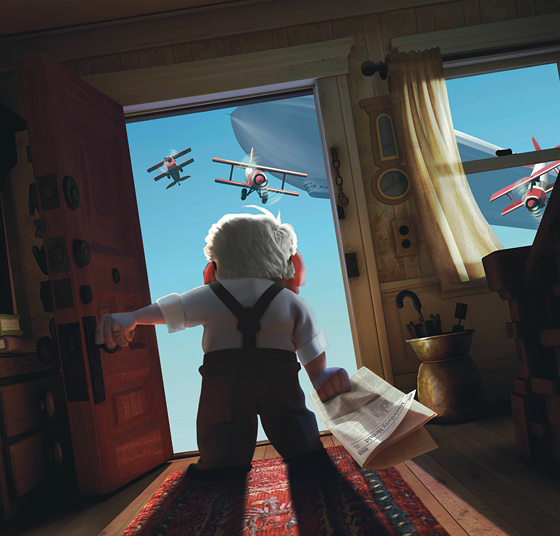 Okay, so I didn't like Up all that much. I didn't hate it. It was certainly better than Cars and I know I tend to expect too much from PIXAR films, so I'm not angry or anything.
And sure, at least it was better than Transformers.
But should that really be our standard?
Let me tell you why I didn't dig Up and then tell you why it matters: It wasn't the dogs who can't talk without special collars but who can fly planes. It wasn't that the great explorer from the beginning of the film somehow garnered an unlimited budget and sci-fi toys that would make Captain Nemo light a cigarette. It wasn't even the fact that his transformation into the villain was utterly and totally spontaneous and unbelievable (or that at the end of the film he's supposed to be over 100 years old but can still go toe-to-toe with our senior-citizen hero).
And it wasn't the annoying kid, the annoying bird, or the annoying voice of the villainous dog.
It was that so many people agree with all of the above but then shrug and say, "But I looooooved it. It was soooo cute."
I was talking with my composer friend just a few days ago and we were discussing how ABC kids Television and the Disney Channel use music not to serve a good story but to compensate for a bad one. Like TGIF's Family Matters or Full House, there comes a time in the show when the "touching music" starts that tells you how to feel, no matter how lame the previous 15 minutes were. This music is usually added to the rockin' interlude before and after commercial breaks to give you a jolt of energy before the laugh track kicks in.
Now, my friend is an amazing composer. He's done great music for great stories. And the people who do the ABC/Disney stuff do fine work and work hard...but I garuntee you they long to do something else. They'd all love to work for PIXAR. (They all probably long to work with my friend).
But PIXAR, the pioneer in computer animation, has gotten so good at creating lush, believable and completely compelling environments that they have, perhaps accidentally, wandered into a new world of story-telling temptation:
They are now tempted to do visually what Full House did musically.
 And this is where Transformers and Up actually have one thing in common: where Transformers uses explosions and Megan Fox's thighs to cover up for a horrible story, PIXAR can now use fluffy clouds and cute birds to cover up for their average story.
Because lets praise it: Up, while not the greatest thing ever, is a elegant concept. And the first 10 minutes should be cut and submitted for best short film for the Academy Awards.
But I don't need to have a touching moment every 5 minutes in order to appreciate a good story, and when the film keeps bombarding me with cutesy "aw" moments I start to get nervous like someone is trying to steal my wallet.
This phenomena begins to devolve the story into a "how much can we get people to feel" game rather than a "what are we trying to say" game. One is sentimental, the other is substantive.
PIXAR is known throughout the world for it's substance. Michael Bay is (usually) not. I'm fine with one inspiring the other...I just want to make sure it's the former inspiring the latter.
Tuesday, June 9, 2009
Teaching as a Subversive Activity
Ever remember thinking the thought in high school or college or church or mosque or synagogue:
"Why in the [insert explicative here] am I learning this!?"
Want to read a book that will make you excited and uncomfortable all at the same time?
Ladies and gentlemen: please meet Neil Postman and Charles Weingartner's Teaching as a Subversive Activity.
A book written in 1969 about education that was so good even Playboy liked it.
 Here's a short excerpt:
Examine the types of questions teachers ask in classrooms and you will find that most of them are what might be technically called "convergent questions,"...[otherwise known as]..."Guess What I'm Thinking" questions. Here are a few that will sound familiar:
-what is a noun?
-[what are the books of the Bible, in order?]
-What is the principal river in Uruguay?
-What is the definition of a nonrestrictive clause?
-What is the real meaning of this poem?
-How many sets of chromosomes do human beings have?
-Why did Brutus betray Caesar?
So, what students mostly do in class is guess what the teacher wants them to say. Constantly, they must try to supply "The Right Answer."...And since it is indisputably (if not publicly) recognized that the..."content" of such courses is rarely remembered beyond the last quiz (in which you are required to remember only 65% of what you were told), it is safe to say that just about the only learning that occurs in classrooms is that which is communicated by the structure of the classroom itself.
What are these learnings?
Here are a few among many, none of which you will ever find officially listed among the aims of teachers [unless in a radical fundamentalist environment]:
-Passive acceptance is a more desirable response to ideas than active criticism.
-Discovering [or creating new] knowledge is beyond the power of students and is, in any case, none of their business.
-Recall is the highest form of intellectual achievement, and the collection of unrelated "facts" is the goal of education.
-The voice of authority is to be trusted and valued more than independent judgment.
-One's own ideas and those of one's classmates are inconsequential.
-Feelings are irrelevant in education.
-There is always a single, unambiguous Right Answer to a question.
If you're hooked, you're in luck. You can buy Teaching as a Subversive Activity here. Or you can download it for free as a pdf here.
"Why in the [insert explicative here] am I learning this!?"
Want to read a book that will make you excited and uncomfortable all at the same time?
Ladies and gentlemen: please meet Neil Postman and Charles Weingartner's Teaching as a Subversive Activity.
A book written in 1969 about education that was so good even Playboy liked it.
Here's a short excerpt:Examine the types of questions teachers ask in classrooms and you will find that most of them are what might be technically called "convergent questions,"...[otherwise known as]..."Guess What I'm Thinking" questions. Here are a few that will sound familiar:
-what is a noun?
-[what are the books of the Bible, in order?]
-What is the principal river in Uruguay?
-What is the definition of a nonrestrictive clause?
-What is the real meaning of this poem?
-How many sets of chromosomes do human beings have?
-Why did Brutus betray Caesar?
So, what students mostly do in class is guess what the teacher wants them to say. Constantly, they must try to supply "The Right Answer."...And since it is indisputably (if not publicly) recognized that the..."content" of such courses is rarely remembered beyond the last quiz (in which you are required to remember only 65% of what you were told), it is safe to say that just about the only learning that occurs in classrooms is that which is communicated by the structure of the classroom itself.
What are these learnings?
Here are a few among many, none of which you will ever find officially listed among the aims of teachers [unless in a radical fundamentalist environment]:
-Passive acceptance is a more desirable response to ideas than active criticism.
-Discovering [or creating new] knowledge is beyond the power of students and is, in any case, none of their business.
-Recall is the highest form of intellectual achievement, and the collection of unrelated "facts" is the goal of education.
-The voice of authority is to be trusted and valued more than independent judgment.
-One's own ideas and those of one's classmates are inconsequential.
-Feelings are irrelevant in education.
-There is always a single, unambiguous Right Answer to a question.
If you're hooked, you're in luck. You can buy Teaching as a Subversive Activity here. Or you can download it for free as a pdf here.
Thursday, June 4, 2009
Art goes Wow.
I love stuff that makes me say, "Wow."
You may be like me, and might actually giggle-- that's right, GIGGLE-- with excitement as you watch this. I don't know how they do it. I know I'll never be able to do it. But I'm sure glad they put "it" on film.
What is it about excellence that is so compelling? How do the arts make me feel the way that I feel?
I remember a night at the Mayan Night club when I was just feeling...terrible. Kind of sick. Kind of grumpy. Kind of everything.
And then a friend of mine, Philip, got up and did this tap-dance thing. By the time he was done...
I felt fine.
How did he do that?
Artists seem to have an unbelievable power, whether they realize it or not. Because what they create evokes awe, confusion, anger, even healing.
The greatest filmmakers, poets, dancers-- they understand this. When Steven Spielberg creates something like Schindler's List, he understands that he's not just telling a story. He's leading.
He wants his art to leave a wake. He wants his art to shape the world.
So what role does art play in your life? What kind of art are you drawn to?
If you're an artist, what kind of art are you creating? What wake are you leaving? Where are you leading people?
Make us go "Wow." But don't leave us there. Take us with you.
You may be like me, and might actually giggle-- that's right, GIGGLE-- with excitement as you watch this. I don't know how they do it. I know I'll never be able to do it. But I'm sure glad they put "it" on film.
What is it about excellence that is so compelling? How do the arts make me feel the way that I feel?
I remember a night at the Mayan Night club when I was just feeling...terrible. Kind of sick. Kind of grumpy. Kind of everything.
And then a friend of mine, Philip, got up and did this tap-dance thing. By the time he was done...
I felt fine.
How did he do that?
Artists seem to have an unbelievable power, whether they realize it or not. Because what they create evokes awe, confusion, anger, even healing.
The greatest filmmakers, poets, dancers-- they understand this. When Steven Spielberg creates something like Schindler's List, he understands that he's not just telling a story. He's leading.
He wants his art to leave a wake. He wants his art to shape the world.
So what role does art play in your life? What kind of art are you drawn to?
If you're an artist, what kind of art are you creating? What wake are you leaving? Where are you leading people?
Make us go "Wow." But don't leave us there. Take us with you.
Tuesday, May 13, 2008
Avant-Garde Demands Buy-In

I was trying to think of a clever way of getting to my point. But I couldn't think of one.
So this is it: the more 'avant-garde' defines a community the less accessible it becomes.
'Innovative' doesn't have to mean weird. Being the R&D of a movement doesn't mean that what we create is unintelligible to the people in our community. When something doesn't communicate, we can't just celebrate that what we created was so 'cutting edge' that people didn't even get it. People have to understand what we're doing, not to make them happy but so that we can lead where they were made to go.
Everything that happens on stage has to communicate. Avant-garde has a place, but it can't be center stage for very long, because avant-garde wasn't made to lead.
It's the icing, but it's not the cake.
Unless we process people along the way. We can be the most innovative, creative, and-- yes-- avant-garde community in the world...
But we have to take our community with us.
We have to explain to them what we're doing and why. We have to do it over and over and over again until they get it. And once they get it, we have to explain it again so that they don't forget.
Why? Because that's what someone, somewhere did for us.
...and because that's what leaders do.
Thursday, May 8, 2008
I can't remember win...

[When I moved from the Carolinas to Massachusetts for school] most of the white Southerners at the time could recite long lists of battles lost and won and argue over the relative merits of Confederate generals. In the North, nobody knew or cared very much about the war, even in a school where many of the students bore surnames made glorious by the exploits of their ancestors in Union arms.]
Walter Mead in his book God and Gold calls this observation 'victor's amnesia.' Mead's point is that there is a tendency for winners in conflict to move past the pain, triumph, and struggle of the past and to move on toward a hopeful and 'peaceful future'-- a pax nike-- one winners forced into existence.
Losers, on the other hand, remember with great pain and agony the trials of defeat. They memorialize it in their history and culture. 'Let us never forget what they did to us!' becomes a mantra and is increasingly ingrained into the cultural ethos as the victors become villains and the vanquished become victims.
Think about it: who usually says 'let's just let bygones be bygones'? The Winner or Loser? Always the winner. Why is it that winners are so eager to forgive and forget?
Because they won.
This doesn't make the victor more virtuous. In fact, often times a victor's willingness to move on is an indictment of their unwillingness to look at their mistakes. They're not seeking to forgive and forget. They want to forget, and so they forgive.
I can't help but wonder: when Jesus defines the essence of kindness as embracing those who do not embrace us, I wonder if he would redefine the essence of victory as embracing those who did not win?
If we can only remember who they were...
Subscribe to:
Posts (Atom)

 Posts
Posts

