Tuesday, August 18, 2009

No Need for Heroes

I don't need a lot of things.

Yogurt? Don't need it. Coffee? Nope.

And if you were to ask, I suppose I would say I don't "need" to be, you know, stronger.

Now, I'm pretty thin. I'm not much help in times of manual labor but I'll do what I can. If I were alive 10,000 years ago my genes would have died with me.

I say I don't need to be stronger, but that's because I'm not living a life that requires me to be stronger. I go to meetings, I write a lot, I go to films, out to eat, I like to travel. Occasionally I like to embarrass myself by playing basketball with my boss. None of these things require a particular degree of strength.

Lifting cars doesn't particularly excite me. Being more helpful on moving day does, but not enough for a $1,000 annual membership to a gym.

I manage my life with the amount of strength that I already have.

After all, it's not like I'm a superhero or something.

In the class I teach at Pepperdine we spend some time talking about heroes.

Whenever the subject comes up it's always a little embarrassing for me. While I have many heroes (and not just my dad-- although he's at the top of the list) I've discovered that a lot of people, especially the older they get, don't have a lot of heroes.

I had one student say to me, "Why should I need a hero?"

And I suppose we don't. Just like I don't need to get stronger.

On the other hand, if I dream of a life that requires a stronger me, then that's who I'll need to become to create the life I want to live.

The same is true for heroes.

After all, what do heroes do? I mean, they inspire us. They give us a picture of ourselves that we could become.

And, unlike a membership to the gym, having heroes are free.

But those things are only valuable if we're desiring to grow. Heroes only appear to us when we have the humility to admit that others are farther down the road than we are. They help us create a better future.

Could that be why there are so few heroes for us today? Not because we don't need them, but because we haven't yet found the dreams for our lives that demand them?

For while we may have no need for heroes, the world most certainly does.

Tuesday, August 11, 2009

Say 'Goodbye' to Goodbyes.

The last three "goodbye" parties I've been invited to I haven't been able to go to.

I wanted to go, but it didn't work out.

Actually, I can't really think of the last "goodbye" party I went to.

I have a friend doing peace work in Palestine that emailed me a few weeks ago. I have friends in South Africa that I tweet with. I have friends in Boston, Denver, New York, Phoenix and Kansas City that I talk on the phone occasionally with.

And those are just my friends that live someplace else. And those friends are totally unrelated to my work.

Now that we have email, cell phones, AIM, Skype, Facebook and Twitter it has become even harder to understand when we are separate or when we are together. Like friends who are dating it's hard to know how to define our relationships.


I now use the same technology that I use to communicate with my South African friends as I do to communicate with people who live 15 minutes away.

And we never say "goodbye."

150 years ago, if a family member moved from Kansas to California, it was highly likely that you would never see them again (and probable that they wouldn't survive the trip, anyway).

Today, I don't even go to the going away party because-- honestly-- what will really be changing? We'll still text. We'll still email. I'll get-- not just Christmas updates-- but hourly updates from my friends on Twitter and Facebook.

150 years ago I wouldn't know if you were dead or alive. Today I'll know what you had for breakfast.

Same distance. Totally different relationship.

I actually spent less time talking with my sister the first year she moved to LA with her family. We were used to talking on the phone, and when she moved 15 minutes away it felt weird to call her.

Have you ever noticed that as your social circles change and shift people tend to get hurt? You move to another city and lose touch with friends. You didn't mean to...it just happened.

But if you wanted to keep in touch you could have. You could have texted, called, emailed, skyped, Facebooked, or DM'd me on Twitter or AIM'd, visited, or-- heaven forbid-- written a letter. Yet you did none of those things.

And I just wanted to let you know that really hurt me.

Yes, you.

And that adds a lot of social pressure to maintain an ever-increasing Rolodex of people you were actually pretty good friends with for a certain period of time. Not that you can't still hold an affection for those people...but that affection will probably not be backed up by any concrete action.

And maybe that's okay.

What is the role of goobyes in a uber-transient and uber-connected society? What is the role of goodbyes in a world where goodbyes are no longer geographically necessary but still physcologically necessary? And what happens to our capacity to make new friends locally when our current social wattage is being used up by people from our pasts or who live in other parts of the world?

Maybe we should have more ruthless evaluations of our own social capacity, where we say "goodbye" to some old friends and to a very, very select few we say "We're still going to talk, even if it's once a year." Or maybe we should stop having goodbye parties and start having "our relationships are going to change and that's okay" parties.

Doesn't mean we can't still be friends.

At least on facebook.

Monday, August 3, 2009

On passion.

"I'm passionate about so many things."

I hear this phrase a lot. Especially with people in their 20s.

We are the generation cursed with endless opportunity. 500 years ago if my last name was Builder I'd be a builder. If my name was Spears that's probably what I would make for a living.

But our names no longer shape who we will become, and it seems as though the sky is the limit when it comes to what we could do with our lives.

It's a time of amazing privilege. And it's an incredible annoyance.

Consequently we are the generation that is "passionate about so many things." But I don't think we mean it when we say it. What we usually mean is that we have the potential to be passionate about a lot of things...but we haven't decided what those things are going to be.

And while waiting for something to be passionate about we're passionate about nothing...not even figuring out what to be passionate about.

The word "passion" is an interesting word. I think when we use it most of the time we use it in the sense that we're interested in something, or that something energizes us or that we enjoy it.

In this sense people can be passionate about yogurtland and urban outfitter sales, nice cars and new iphones.

But this is only half of meaning of "passion."

The word "compassion" means literally "to suffer with." The word "passion" means simply "to suffer."

"The Passion of the Christ" is the narrative of the final hours of Jesus' life as he is executed by the Roman government.

Parents, almost all parents, are passionate about their kids. Children bring parents such joy and they require such great sacrifice. Gandhi was passionate about Indian independence. Martin Luther King, Jr. was passionate about Civil Rights and, later, the politics surrounding the Vietnam War. Children, Independence, Civil Rights, Peace. These are all things they suffered for. These were things they were passionate about.

Artists are passionate about art. Composing, writing, painting and dancing-- while all in some sense euphoric and pleasurable-- are also acts akin to giving birth. Sometimes creating just hurts.

You know you're passionate about something when you're willing to suffer for it.

So most of us aren't "passionate about a lot of things." That will only come once we have the courage to sink our teeth into something.

The world is full of causes worthy of our full devotion. Pick one and go.

Cellphones and Hand Grenades

Watch the two 60-second videos below. One is a commercial for a Israeli phone company where a bunch of soldiers play soccer with Palestinians on the other side of the separation barrier. The other is a spoof of the commercial used with real footage of a group of Palestinians who actually tried kicking a soccer ball across the real fence. It's my first experience seeing actual footage of tear gas and grenades.


My first thought that the spoof was tragically hilarious. And if the short film wasn't created by a company more committed to selling phones than creating peace, then of course it would have seemed more sincere.

But either way, both shorts represent what art can be at it's best: a picture of what we hope the future will be and a picture of how the world really is. Vision and Reality. Hope and Sobriety.

It's also a picture of the prophetic role artists can play in culture: helping us see things as they really are and inspiring hope that they don't have to stay that way.

Imagine the day when vision and reality become the artist's paintbrush not simply to sell phones, but to lead a community or city or country out of the world as we know it and into a world we could barely dream of.

There are a few already creating this world. We need more. See one community of artists' attempts here.

Monday, June 29, 2009

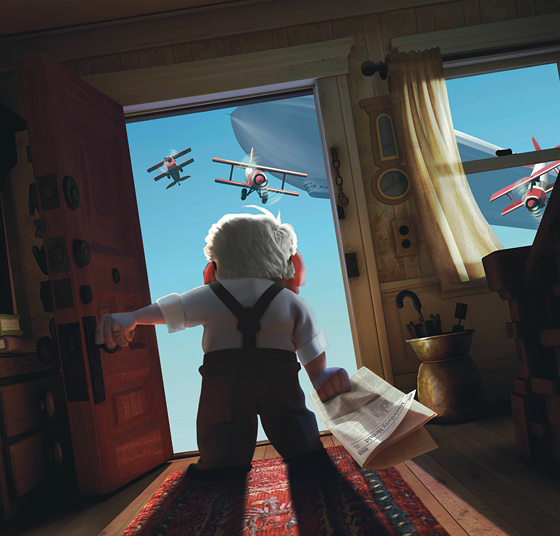
When Up is Down. (part 1)

Okay, so I didn't like Up all that much. I didn't hate it. It was certainly better than Cars and I know I tend to expect too much from PIXAR films, so I'm not angry or anything.

And sure, at least it was better than Transformers.

But should that really be our standard?

Let me tell you why I didn't dig Up and then tell you why it matters: It wasn't the dogs who can't talk without special collars but who can fly planes. It wasn't that the great explorer from the beginning of the film somehow garnered an unlimited budget and sci-fi toys that would make Captain Nemo light a cigarette. It wasn't even the fact that his transformation into the villain was utterly and totally spontaneous and unbelievable (or that at the end of the film he's supposed to be over 100 years old but can still go toe-to-toe with our senior-citizen hero).

And it wasn't the annoying kid, the annoying bird, or the annoying voice of the villainous dog.

It was that so many people agree with all of the above but then shrug and say, "But I looooooved it. It was soooo cute."

I was talking with my composer friend just a few days ago and we were discussing how ABC kids Television and the Disney Channel use music not to serve a good story but to compensate for a bad one. Like TGIF's Family Matters or Full House, there comes a time in the show when the "touching music" starts that tells you how to feel, no matter how lame the previous 15 minutes were. This music is usually added to the rockin' interlude before and after commercial breaks to give you a jolt of energy before the laugh track kicks in.

Now, my friend is an amazing composer. He's done great music for great stories. And the people who do the ABC/Disney stuff do fine work and work hard...but I garuntee you they long to do something else. They'd all love to work for PIXAR. (They all probably long to work with my friend).

But PIXAR, the pioneer in computer animation, has gotten so good at creating lush, believable and completely compelling environments that they have, perhaps accidentally, wandered into a new world of story-telling temptation:

They are now tempted to do visually what Full House did musically.

And this is where Transformers and Up actually have one thing in common: where Transformers uses explosions and Megan Fox's thighs to cover up for a horrible story, PIXAR can now use fluffy clouds and cute birds to cover up for their average story.

Because lets praise it: Up, while not the greatest thing ever, is a elegant concept. And the first 10 minutes should be cut and submitted for best short film for the Academy Awards.

But I don't need to have a touching moment every 5 minutes in order to appreciate a good story, and when the film keeps bombarding me with cutesy "aw" moments I start to get nervous like someone is trying to steal my wallet.

This phenomena begins to devolve the story into a "how much can we get people to feel" game rather than a "what are we trying to say" game. One is sentimental, the other is substantive.

PIXAR is known throughout the world for it's substance. Michael Bay is (usually) not. I'm fine with one inspiring the other...I just want to make sure it's the former inspiring the latter.